

A Reverse Osmosis System gives you purified water from the faucet with a not too complicated set up. In this article we’ll give you a rundown on the best Reverse Osmosis Systems for your home.
Sure, you can reduce contaminants from drinking water or improve the taste and smell of tap water with water filters in refrigerators and pitchers. But with a Reverse Osmosis System you’ll be able to get clean water straight from the faucet!
These multiple stage water filtration systems remove up to 99% of total dissolved solids (TDS) from your water supply, giving you clean and fresh tasting water.
What is a Reverse Osmosis System?
While there are a lot of water filtration options out there, a Reverse Osmosis System uses special filters that are so fine almost nothing but water can pass through them, removing contaminants and providing you with gallons of purified water daily.
Are Reverse Osmosis Systems Eco-Friendly?
We’ve mentioned that RO systems will give you cleaner, safer and better tasting water but we haven’t told you about the eco-friendly benefits that come with it.
First off it totally eliminates your need for bottled water! Around 10 million tons of plastic trash ends dumped in the ocean and a substantial amount of that trash is made up of plastic water bottles.
With your RO system giving you pure water on demand you won’t have a need to buy bottled water again, just invest in a reusable bottle to fill at home and take with you when you go out and you’ll not only be helping to save the oceans but you’ll also be saving some cash!
RO systems also produce waste water, this isn’t as gross as it sounds, it is just the unclean elements that have been filtered out of your water in liquid form and there are ways to re-use this water that can benefit the environment. Here’s a few ideas in how you could re-use your wastewater:
- Watering plants – Plants don’t need the cleanest water to survive and re-using RO wastewater is a great way to water your plants while saving both your purified water and the standard water from the faucet.
- Household chores – Things like washing the dishes, clothes moping etc. all make use of a fair amount of water but these tasks don’t rely on super clean water, instead the soaps you use do the heavy lifting when it comes to actually cleaning things. So, your RO wastewater would be great to use for these purposes.
- Toilets – We don’t need to use clean water at all when flushing away our bodily wastes, yet we do. You can hook up your RO’s water output to toilet input to greatly cut down your total water consumption.
- Carwash – Again we don’t really need to use fresh water from the hose to wash the car. You can store your RO wastewater until the next time you want to clean your car. If you think the wastewater might be too saturated with chemicals and unable to mix with detergent then you can dilute it with a bit of water from the faucet to balance the concentration.
All of these examples will help cut down your daily water usage around the house and are easy ways to start thinking more eco mindedly.
There are a few factors to consider when shopping for a Reverse Osmosis System, including plumbing requirements, water output, the number of filtering stages and how demanding installation might be. Here we’ll run you through the important bits to remember while looking for a system of your own:
Plumbing requirements
Before investing in a system, it’s best to ensure you actually have the space to install one. This is because these systems are quite chunky, they use multiple filters and a rather large storage tank.
So unfortunately, that means you’ll probably have to empty out whatever you have stored under your sink and if you have a garbage disposal it may get in the way of your Reverse Osmosis system.
You’ll also need to install a new faucet as the Reverse Osmosis system requires its own, you can do this by either drilling through your sink edge or counter top.
Reverse Osmosis Systems also make use of an air gap or non-air gap faucet. RO systems sperate water and its impurities in liquid form. The waste water runs through an air gap and drips into an outlet tube connected to the sink drain.
An air gap faucet stops this contaminated water from being taken back into the RO system. If the faucet in not near the RO system and not sharing a discharge line, there is no need for an air gap faucet.
Water Output
Reverse Osmosis systems storage tanks tend to fill rather slowly about 50 gallons per day which equals around 1 gallon every 30 minutes so you should be selective about when you use your RO system, its main use should be for drinking or cooking water.
If your family will be making use of the filtered water more often then you could consider a high output system which can filter 90 gallons per day or even a tankless system that can provide 400 gallons!
Waste Water
Reverse osmosis systems are sometimes criticized for creating a lot of waste water. This is unfortunately true. Unlike traditional filters that removes solid contaminants, a RO system removes them in liquid form and this creates quite a lot of wastewater called brine. RO systems can produce between 3 – 25 gallons of brine per gallon of purified water!
With this in mind, if you don’t think you’ll re use the waste water like we highlighted previously then you should look for RO systems that claim to have a low ratio of waste to pure water.
Tank Size
It’s worth noting that tank sizes usually aren’t as they are listed, this is because in Reverse Osmosis Systems the tanks contain a metal bladder and a bubble of air in order to create enough pressure to push the water through when the tap is open.
The actual amount of water holding potential varies from system to system depending on how much air pressure is needed inside the tanks.
This is important to consider in order to ensure your tank will fit your families daily water needs.
Filtering Stages
Reverse Osmosis systems typically have from 4 – 7 filtering stages though experts agree that 4 are enough to purify water. The 4 filtering stages are made up of a RO membrane that removes dissolved substances, a filter that removes harmful contaminants, microorganisms and bacteria, a filter that removes small 1-micron particles and excessive amounts of minerals and finally a post filter that removes odor and taste from the water.
The Larger systems with 7 stages add minerals to the water that may have been lost in previous stages of filtration like calcium.
High Pressure Pump
RO systems need a water pressure of at least 50 pounds per square in (PSI) This high pressure is needed to push the water through each of the filtering stages in your system and still maintain good pressure at the tap. If you lack the water pressure needed a RO booster pump can increase the systems water pressure up to 80 PSI.
Valves
RO systems have a shut off valve which stops the tank from backflowing when it’s full. The valve then reopens automatically when the tanks pressure drops enough to allow the water to enter the system again.
Installation
The difficulty of installation depends on the systems itself but if you are okay to follow the instructions for your system and have some DIY skills then it shouldn’t be too difficult to do yourself! You can always call a plumber to fit it for you but this will likely cost around $50 – $70 an hour.
Our recommended systems
Here’s our top picks for Reverse Osmosis Systems. We have tried to pick out standard, counter top and tankless Reverse Osmosis systems to hopefully help you find the one that’s best suited for your needs. These promise efficient wastewater to purified water ratios as we’re all about living as unwasteful as possible.
AquaTru Reverse Osmosis System
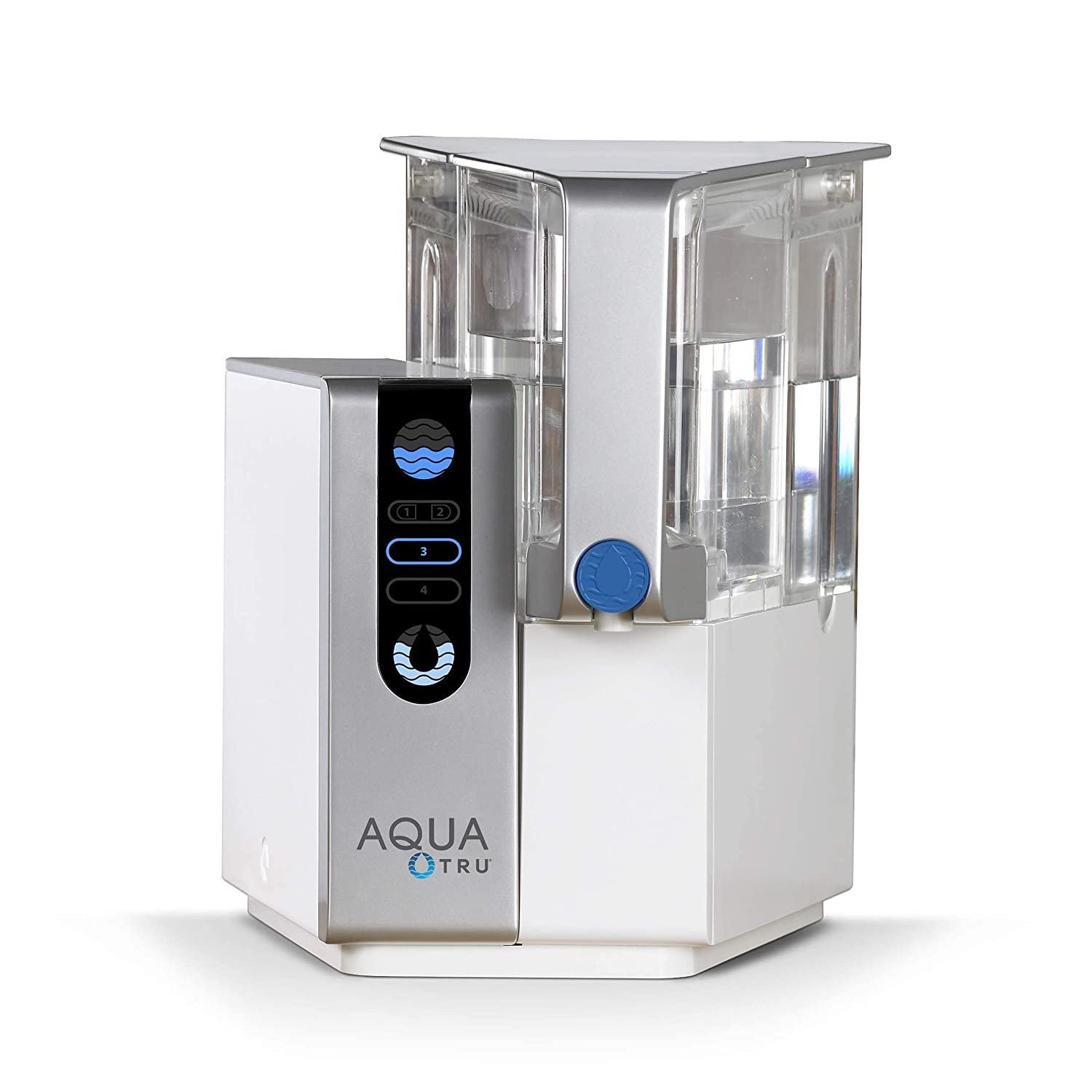
The AquaTru is a countertop reverse osmosis system. It has been tested and certified by the NSF as being effective in removing microplastics, toxins, carcinogens and other pollutants.
It has a simple and compact design making it perfect for those tight of space. The AquaTru system is super easy to install and use, giving you pure water at the push of a button.
Pros
- Easy to install and set up
- Sleek design
- Low price point
Cons
- Small Water Tank
- Has fewer filtration stages
- No remineralization
Waterdrop Reverse Osmosis System

This Waterdrop RO system is tankless! It’s designed to filter water on demand, meaning it will filter the water and fill your cup simultaneously.
It has a super compact and slim design to fit perfectly under the sink. It’s leak proof and if it detects a leak within its system, it will automatically cut of electricity and water supply, making this system a super safe choice!
Pros
- Has 7 filtration stages
- Small form factor takes up less space
- Easy to install and set up
Cons
- Expensive
- No remineralization
- Popular so filters are often out of stock
Waterdrop G2 Tankless Reverse Osmosis System

This Tankless system is capable of boosting your purified water to an incredible 400 gallons per day! The filters in this system are design to last longer than the standard 6 months.
So not only is maintenance low demand with this system, when it comes time to change the filters it can be done quickly and easily with a simple twist and pull process.
Again, it has a small form factor so it can be installed without taking up much room.
Pros
- Very easy to install
- No water wastage
- Long filter life span
- Eight layers of filtration
- Few hoses and pipes which mean smaller chance of leakage
Cons
- No remineralization
- Noisy pump
Express Water RO5DX Reverse Osmosis System
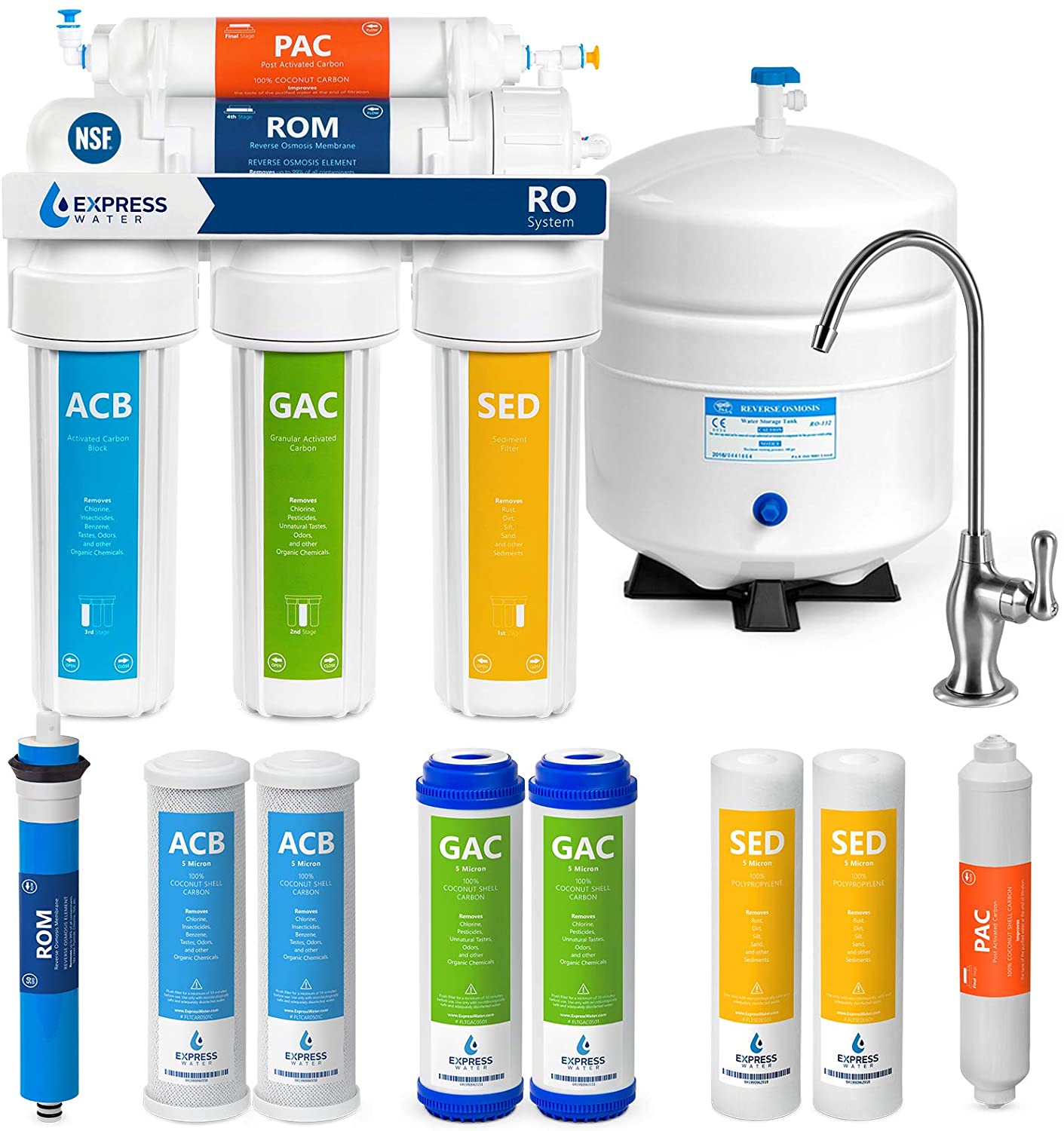
The Express Water system produces 50 gallons per day and has a low-price tag making it a great choice for those on a budget. This is a 5-stage system that has a leak detection system and it’s also easily customizable so you can add additional filtration stages to your liking.
This system has a little more involved set up than the others on our list and it’s also the biggest but they have on demand support from experts ready to talk you through the process.
Pros
- 5 stage system
- Easy installation
- Leak detection
Cons
- Extended maintenance is required
- No remineralization
Express Water UV Reverse Osmosis System

This RO system is essentially the big brother of the previous system we highlighted. This has an 11-stage filtration system that includes an ultraviolet sterilizer and a filter that removes odor and taste giving you ultra-pure drinking water.
With so many stages its worth remembering that when it comes time to replace the filters it may not only be a time-consuming task but also a costly one.
Pros
- 11 stage system
- UV sterilization
- Remineralization
Cons
- Hard to install
- Produces more wastewater than clean water
In Summary,
Hopefully this will help you make an informed decision if you decide to buy a system for your needs. Just be sure to consider each aspect of the different RO systems as we highlighted. It’s also best to use a water testing kit before purchasing a system.
This way you’ll know your current quality of water which will help you pick and even more well-suited system and you’ll be able to test it again after installing your RO system to really see how well your new system is operating.
If you have any questions or advice, please share them in the comments below as we love to hear from you!
